The Unofficial Layer
Notes on the Community That Never Gets Counted

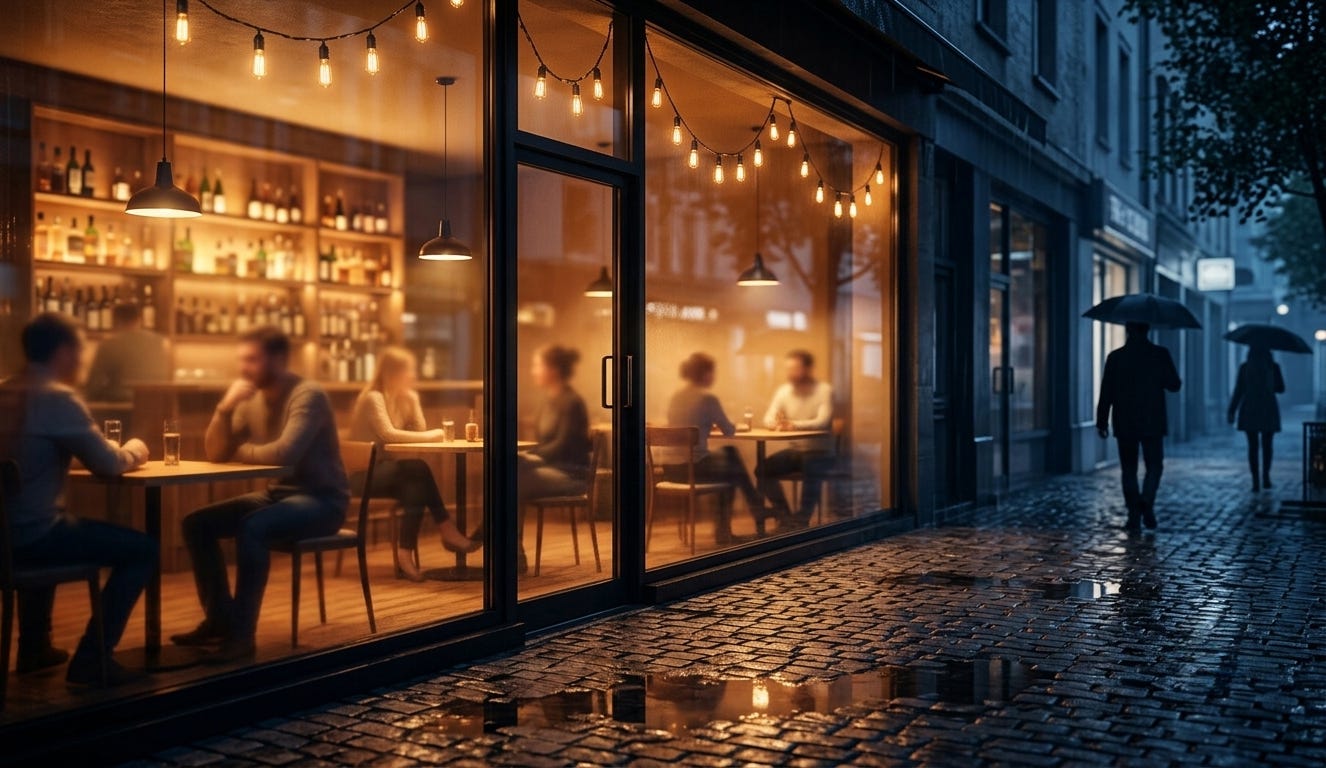
There is a kind of community that never gets counted.
Not because it’s rare. Because it leaves no record. No contracts signed, no memberships renewed, no attendance taken. It doesn’t appear in census data or organizational charts or the categories we use to sort relationships. It has no bylaws, no founding document, no official anything. And yet it is, for most people, where the texture of a life actually forms; not in the formal structures, which are real and necessary, but in the layer that exists beneath them, between them, in the margins they don’t quite reach.
I call it the unofficial layer.
It’s built from things that don’t announce themselves. The barista who remembers your order but not your name. The regulars at the tasting room you recognize by sight but have never formally met. The table where no one sent invitations but everyone arrived anyway, because it’s Tuesday and this is what happens on Tuesdays, and that rhythm: unremarkable, unchosen, and indispensable — is the whole of it. You didn’t decide to belong here. You returned, and returned again, and at some point the returning became the belonging, and by the time you noticed it you were already inside it.
This is not how we are taught to think about community. We are taught to think about it in terms of choice and commitment: the relationships you build deliberately, the groups you join, the people you decide are important. Those things are real, but they are not where most of life actually takes place. Most of life takes place in the spaces between them: in the repeated encounter that never quite becomes a friendship but shapes your week more than most friendships do, in the room that feels like yours without your having claimed it, in the accumulation of presence that produces, over time, something that functions like belonging without ever having been declared as such.
The spaces that host this kind of life share a particular logic. They sit between home and work, between the private and the institutional, between the obligatory and the anonymous-- open enough that arrival requires no explanation, familiar enough that faces repeat without planning, unhurried enough that presence itself becomes the point rather than the means to some other end. The wine bar. The neighborhood restaurant. The tasting room built for lingering rather than throughput. These spaces don’t create the unofficial layer so much as they hold the conditions under which it can form, and the distinction matters, because the layer itself is not a product of design.
It is a product of time.
What time does, in these spaces, is specific. It converts strangers into familiar strangers, which is a category of its own-- neither the stranger you have no relationship with nor the friend you have chosen, but something in between that has its own particular warmth and its own particular fragility. The familiar stranger is the person you nod to. The person whose presence you register without registering consciously. The person whose absence, on the evening they’re usually there, produces a small and slightly puzzling sense of wrongness. You didn’t know you were tracking them until they weren’t there to track. That is the unofficial layer making itself felt... subtly, as it always does, through the texture of what’s missing rather than the weight of what’s present.
Wine finds its way into this layer not as event or occasion but as atmosphere.
An open bottle signals something before anyone has said a word: nobody is rushing. The agenda, whatever it was, has eased. The evening is no longer a transaction to be completed but weather to be inside of, something happening around you and through you that you are participating in without directing, that will run its own course at its own pace and leave you somewhere you didn’t entirely plan to be. That quality: the sense of being inside something rather than managing it-- is what the unofficial layer feels like when it’s working, and wine, more reliably than most things, creates the conditions for it.
Why wine specifically? It’s worth sitting with the question rather than answering it too quickly. Some of it is pharmacology. Some of it is probably what wine represents... the visible choice to spend time rather than compress it, made before anyone has spoken a word. Some of it may simply be the bottle itself: a natural duration that runs out at roughly the pace of real conversation, a sort of shared clock that nobody set and nobody is watching, creating an implicit agreement that the evening will last at least this long and that what happens inside that duration is worth letting happen. You don’t have to resolve which of these is true. All of them probably are, in different rooms, on different evenings, for different people. Someone pours for the person next to them before pouring for themselves. That person returns the gesture from their own glass. The wine moves, and in moving it connect: tables that never introduced themselves, conversations that had no business beginning, an evening that became something other than what anyone arrived intending. You can’t quite engineer this. You can only create the conditions and wait.
Maybe it’s just that. Maybe what wine represents, in these spaces, is the willingness to spend time rather than optimize it, and that willingness, signaled by the open bottle, the unhurried pour, the glass set within reach of everyone rather than kept close, is what the unofficial layer runs on. It runs on the repeated small election to show up, to stay, to refill the glass when it runs low, and to make room at the table for whoever walks in next. None of these acts is large. Together, over enough evenings, they produce something that functions like infrastructure; not the official infrastructure of institutions and organizations, which is built deliberately and maintained deliberately, but the unofficial infrastructure of a life: the web of recognition and familiarity that makes the formal structures bearable and, sometimes, possible.
It is worth sitting with why this matters, given how little official weight the unofficial layer carries. It doesn’t go on resumes. Nobody writes policy about it. In a world that prizes what’s countable, things that aren’t get treated as secondary (nice to have, pleasant while they last, not quite seriou) but the unofficial layer is not secondary to the things that can be counted. It is, in many cases, what makes those things worth having.
The friendships that make a workplace bearable don’t usually begin at work. They begin in the space around work... the lunch that wasn’t a meeting, the drink after that wasn’t an agenda, the slow accumulation of shared time that eventually produced enough trust to matter when trust was needed. The neighborhood that feels like a neighborhood rather than a zip code, doesn’t feel that way because of its institutions, though institutions help. It feels that way because enough people have returned to enough of the same places often enough that the place itself has developed a kind of memory: a set of familiar faces and repeated rhythms that holds the community’s shape between any individual’s visits. The loose tribe who shows up when something hard happens-- not because they’re obligated, but because they noticed-- and they learned to notice in the unofficial layer. That is where attention of that kind gets trained.
What the unofficial layer requires, and what makes it both fragile and irreplaceable, is the habit of return.
Not the dramatic gesture or the formal commitment, but the more ordinary choice: to come back, to let recognition accumulate, to open another bottle when the first one runs low and stay a little longer than you planned. These choices don’t feel like choices in the moment. They feel like just the way the evening went: the glass that got refilled because it was empty, the chair pulled out because someone was standing, the hour that passed because nobody mentioned leaving. They are choices, nonetheless and over time they are consequential ones, because what they build-- slowly, without announcement, through the accumulation of unremarkable evenings, is a layer of life that cannot be built any other way.
You cannot join the unofficial layer. You can only inhabit it, through repeated presence, until one day you realize you are part of it... that the room knows you in its own low-key way, that the faces have become familiar, that the evening has a quality it didn’t used to have, and that this quality is something you would miss if it disappeared, though you would have trouble explaining to anyone exactly what was gone.
That difficulty of explanation is part of what makes the unofficial layer vulnerable.
What cannot be named clearly cannot be protected clearly. When the conditions that allow it to form come under pressure, when the by-the-glass price moves past the threshold where showing up feels easy, when the room that once invited lingering starts moving tables faster, when the person who used to guide you through the list is no longer there to do it — the layer doesn’t collapse dramatically. It withers gradually, in ways that are easy to miss until you step back and notice that the familiar faces have become occasional faces, that the Tuesday rhythm has become a Saturday occasion, that the room that felt like yours has become a room you visit.
This withering is not registered anywhere. No metric captures it. No report tracks the disappearance of the unofficial layer, because the unofficial layer was never counted in the first place.
What gets counted is what gets protected, and what doesn’t get counted disappears without record — not with a dramatic exit, but with absence, the slow accumulation of evenings that didn’t happen, of bottles that weren’t opened, of rooms that people stopped returning to and eventually stopped thinking about returning to at all.
The unofficial layer doesn’t get counted. But it is where life happens... not the life that goes on the record, but the life that makes the record worth having. The texture of the week. The weight of the ordinary evening. The sense that the places you return to are places that, in their particular way, return the recognition.
Once it’s gone, it is very hard to get back.
Not because it requires anything extraordinary to build. It requires only time, and repetition, and the kind of spaces that make both feel worth it.
And someone, at some point, who opens the bottle.